

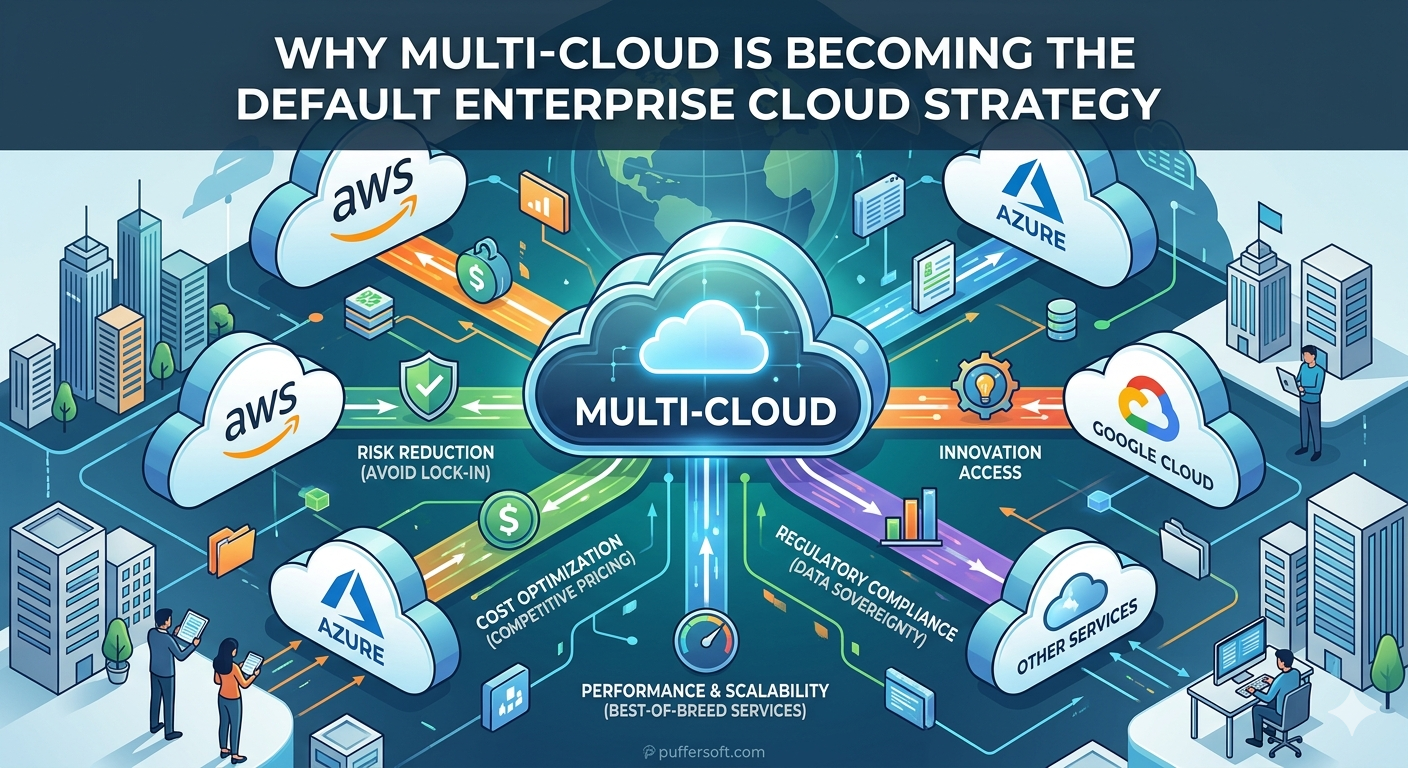
Why Multi-Cloud Is Becoming the Default Enterprise Cloud Strategy
The Shift Beyond Single-Cloud Thinking
In the last ten years, companies have evolved from trying out cloud computing to using digital transformation throughout their business. At the beginning of this journey, many businesses adopted a single vendor to host their cloud infrastructure. A company would choose one cloud vendor to work with, typically either AWS or Azure and then build everything on top of that vendor’s services.
As workloads matured and business requirements grew more complex, the limitations of that approach became harder to ignore. Vendor lock-in, unpredictable pricing, geographic data restrictions, compliance requirements, and gaps in specialized services pushed enterprises to reconsider.
The boardroom question has shifted. It’s no longer “Which cloud vendor should we use?” It’s “How do we build a resilient, scalable multi-cloud strategy that aligns with our business goals?” That shift wasn’t accidental; it was driven by real operational pain.
What Is a Multi-Cloud Strategy?
A multi-cloud strategy means deliberately using more than one public cloud provider to develop, run, and deliver applications, data, and services, rather than consolidating everything under a single vendor or allowing ungoverned shadow IT to sprawl.
Common Examples of a Multi-Cloud Strategy Include:
- Running infrastructure for performing analytics on a different provider than the one running mission-critical applications.
- Using different public cloud providers together. For example, using an AI service from one provider, and a storage service from a different provider, etc.
It’s worth distinguishing this from hybrid cloud, which combines public and private cloud environments. Multi-cloud refers specifically to using multiple public cloud providers in a coordinated way.
When implemented well, multi-cloud strategies improve resilience, negotiating leverage, performance, and architectural flexibility.
The Business Drivers Behind Multi-Cloud Adoption
After working with enterprise IT teams across industries, four drivers come up consistently:
● Risk Mitigation
No provider has a perfect uptime record. Distributing workloads across providers reduces dependence on any single point of failure, strengthening business continuity and disaster recovery.
● Regulatory & Data Sovereignty Requirements
Large global companies have to comply with the local rules and laws of the country; therefore, using the multi-cloud model allows you to maintain compliance while offering greater choice in where you can place your workloads.
● Cost Optimization
Pricing model differences vary greatly by provider, and placing your workloads into different providers provides you with both competitive leveraging opportunities as well as optimising for the specific workload type, thus reducing your total cost to operate in the cloud.
● Access to best-in-class innovation
Different providers excel at different things; therefore, by using the multi-cloud model, you can access the best future innovations and newest technology without any restrictions or constraints.
Cloud adoption is more about providing business agility than just simply providing Infrastructure.
Best-of-Breed Services: Using Each Cloud’s Strengths
One of the biggest reasons organizations use Multi-Cloud Strategies is to access quality product offerings from the various providers. An example of this would be that one provider might have excellent machine learning toolsets, and another would have great integration capabilities for getting to enterprise identity via their platforms; and Another would have excellent capabilities for container management.
Many organizations have started using AWS for their cloud computing solutions, because of Amazon’s broad global coverage and its ability to integrate with Microsoft’s enterprise software products through Azure. Using Multi-Cloud Strategies in this way does not mean you are diluting your enterprise, but it is a way to create targeted specialization in your enterprise. Having redundant capabilities is not ideal but does lend itself to providing additional opportunities for improving overall performance.
When properly implemented (typically leveraging containerization technologies such as Kubernetes), infrastructure as code, and an API-based architecture, the use of Multi- Cloud strategies provides an organization with a practical means of achieving portability as opposed to just a theoretical consideration.
The Real Challenges of Multi-Cloud
To be frank, managing a multi-cloud environment is pretty complicated. There is a lot of operational complexity that comes from managing several platforms and that includes monitoring, governance, networking, and security overhead. Without a single source of visibility into how everything is performing, costs and risks associated Using multiple clouds can get out of control.Your engineers therefore need to be experienced with more than one ecosystem and this means you will also have increased training and hiring needs.
Every different cloud vendor has its own mechanisms for enforcing security controls so if you want to ensure that your teams will consistently enforce security, you need to have mature and defined governance frameworks in place. The act of moving large amounts of data from one cloud provider to another can create challenges related to latency and cost.
In my experience, the greatest point of failure within a multi-cloud is not the technology but rather the organisations who operate within that environment. Without having standardised processes in place and with poor DevOps discipline, multi-cloud will quickly turn into “chaos”.
Real-World Adoption Across Industries
Adoption Rates are Rising Across All Industries
Financial services.
Banks use multi-cloud to meet regulatory redundancy requirements and maintain resilience for mission-critical applications. Distributing workloads across providers means a single provider outage doesn’t take down core banking systems.
SaaS Providers
Scaling startups increasingly deploy across multiple providers to reduce latency for global user bases and avoid single-provider downtime events affecting all customers simultaneously.
AI and Analytics Workload
Enterprises are using one provider’s AI platform for model development and inference while running transactional systems on a separate, more cost-optimized provider. This separation allows teams to optimize each workload independently rather than accepting a single provider’s trade-offs across both.
When Multi-Cloud Makes Sense and When It Doesn’t
Multi-cloud is the right choice when:
- You’re running an enterprise with complex, varied workloads
- Regulatory requirements demand geographic or vendor flexibility
- Uptime is mission-critical and single-provider risk is unacceptable
- Your team has mature DevOps practices and cloud governance frameworks in place
Multi-cloud is the wrong choice when:
- You’re an early-stage startup with limited engineering resources
- Operational simplicity is more valuable than redundancy at your current scale
- Your workloads are tightly coupled and difficult to separate across environments
A single, well-architected cloud environment will almost always outperform a poorly governed multi-cloud setup. Multi-cloud should be a deliberate strategic decision not a trend to chase.
The Future of Multi-Cloud Strategy
Abstraction and automation are the future of Multi-Cloud Strategy and this is a huge part of the reason for the adoption of new trends. Two main types of trends I am seeing right now that will accelerate in the coming years include:
● Cloud agnostic architecture built upon containerization.
● Unified observability platform services.
There will also be a trend towards centralized policy management systems, AI-based tools for optimizing costs, and the integration of edge computing. With the maturation of tooling and as operational friction decreases, platform engineering teams will develop their own internal developer platforms to provide greater abstraction for underlying cloud providers.
Within 5 years, developers will not be concerned with which cloud they are using to deploy and will instead deploy applications to a company-owned and managed platform that will determine where to send the application’s workload based on data and predictive algorithms. This is where everything is progressing.
Conclusion: Multi-Cloud as the New Operating Standard
The transition from single-cloud to multi-cloud strategies reflects an evolution in the way enterprises manage their technology assets. Enterprises require flexibility, agility, innovation, and negotiation leverage related to their cloud infrastructures. Therefore, enterprise implementations of multi-cloud strategies must be governed with discipline by:
● Implementing strong governance processes
● Adopting mature DevOps methodologies
● Establishing centralized monitoring of all cloud environments
● Having cost transparency
● Maintaining security standards across all cloud infrastructure providers
When implemented in a structured way, multi-cloud creates a strategic advantage for organizations versus being a dependency on cloud vendors.
In my work consulting and advising enterprises, I’ve watched multi-cloud evolve from an experimental architecture to the default operating model for organizations that need scalable, robust digital infrastructure. The question is no longer whether to adopt it; it’s whether your organization has the discipline to do it well.
Read More: Multi-Cloud vs Hybrid-Cloud, which one fits your enterprise