

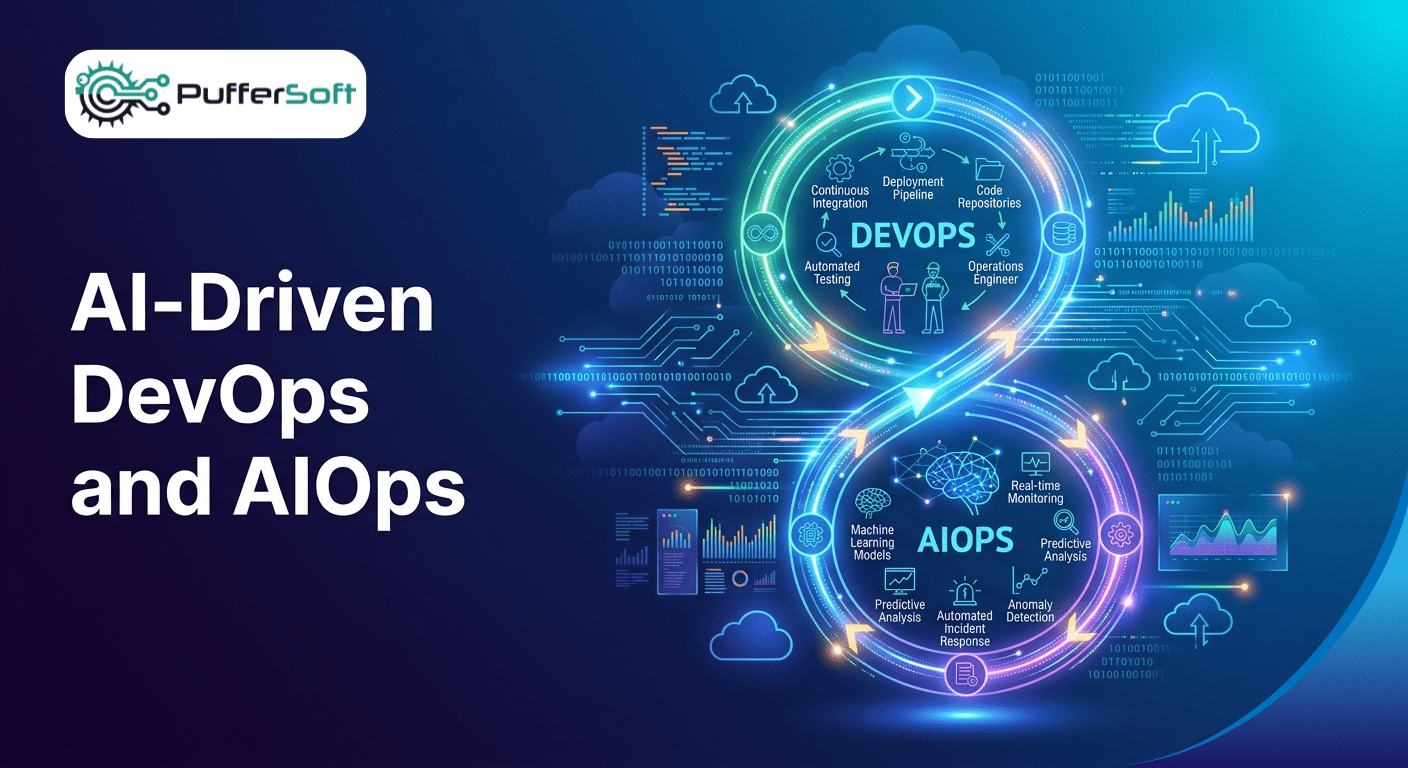
AI-Driven DevOps And AIOps
Artificial Intelligence for IT Operations (AIOps) automates IT processes, including anomaly detection, event correlation, ingestion, and processing of operational data by leveraging big data and machine learning.
With AIOps, teams can significantly reduce the time and effort required to detect, understand, investigate, and resolve incidents at scale. Being able to save troubleshooting time allows IT teams to focus on higher-value tasks and projects.
Five benefits of AIOps
- Supports your workforce
Highly-skilled DevOps and operations teams can become overwhelmed by manual and tedious data analytic work. AIOps allows them to automate these tasks and offset parts of their workload. By delegating tedious analysis to the AIOps solution, they can focus their expertise where it is more critically needed. - Accelerates development of new services and products
AIOps lets your business move faster. With the support of AI-based analytics, your teams can fast-track new IT services and features. By surfacing the most relevant information within an overwhelm of event and telemetry data AIOps also makes your incident management processes more efficient. - Offers a broad view of the IT environment
AIOps solutions may leverage data lakes or data warehouses to efficiently store and aggregate disparate data streams within a centralized location. Cross-functional dashboards and analytics bring it all together so operations teams don’t have to divide their attention across multiple siloed views. - Increases customer satisfaction
AIOps also monitors performance elements such as response times, usage, and availability. Predictive analytics help prevent incidents and outages, letting you resolve problems and roll out upgrades faster and better. As such AIOps helps you give your end user a seamless experience, reflecting well on you and your brand. - Saves money
AIOps decreases Mean Time to Resolution (MTTR) and stops outages before they start. It can also offer insights into what workloads are driving costs within your organization. By fixing costly mistakes faster and using your teams more efficiently, AIOps gives you extra room in your budget.
AI-Driven DevOps is reshaping how modern infrastructure is designed, operated, and optimized. By embedding artificial intelligence into DevOps workflows, organizations can predict failures, automate remediation, strengthen security, and optimize cloud costs at scale.
What Is AI-Driven DevOps?
AI-Driven DevOps is the integration of artificial intelligence and machine learning into DevOps processes to enhance monitoring, automation, decision-making, and optimization.
It enables systems to:
- Analyze logs, metrics, and traces in real time
- Detect anomalies before users are affected
- Predict failures and performance degradation
- Automate remediation and scaling decisions
- Improve deployment quality and security posture
Key Pillars of AI-Driven DevOps
1. Intelligent Infrastructure Monitoring
Traditional monitoring systems alert teams after something breaks. AI-Driven DevOps shifts monitoring from reactive to predictive.
AI models analyze historical and real-time data to:
- Detect memory leaks early
- Predict disk or CPU exhaustion
- Identify abnormal traffic patterns
- Flag potential security incidents
2. Predictive Incident Management
Incident response is one of the most powerful use cases of AI-Driven DevOps.
Instead of waiting for alerts, AI systems can:
- Forecast failures minutes or hours in advance
- Identify root causes automatically
- Trigger auto-healing workflows
- Reduce human intervention during critical incidents
3. Smarter CI/CD Pipelines
Modern DevOps teams deploy code multiple times a day. AI improves CI/CD pipelines by:
- Selecting the most relevant test cases
- Detecting flaky or redundant tests
- Predicting deployment risks
- Preventing unstable releases
4. AI-Powered Security and Compliance
Security has become a top driver for AI-Driven DevOps adoption in 2026.
AI enhances DevSecOps by:
- Detecting behavioral anomalies
- Identifying zero-day attack patterns
- Monitoring access and privilege misuse
- Enforcing compliance continuously
5. Autonomous Cloud Cost Optimization
Cloud waste remains one of the biggest pain points for organizations.
AI-driven systems:
- Identify idle or underutilized resources
- Automatically right-size compute and storage
- Optimize Kubernetes workloads
- Predict future cloud spend
What is AI Driven Development Life Cycle (AI-DLC)?
AI-DLC is an AI-centric transformative approach to software development that emphasizes two powerful dimensions:
- AI Powered Execution with Human Oversight: AI systematically creates detailed work plans, actively seeks clarification and guidance, and defers critical decisions to humans. This is critical since only humans possess the contextual understanding and knowledge of business requirements needed to make informed choices.
- Dynamic Team Collaboration: As AI handles the routine tasks, teams unite in collaborative spaces for real-time problem solving, creative thinking and rapid-decision-making. This shift from isolated work to high-energy teamwork accelerates innovation and delivery.
AIOps vs. DevOps
DevOps represents a culture shift for organizations. It streamlines processes across development and operations to enable a more efficient software release and development lifecycle. Both AIOps and DevOps highlight the benefits of automation — removing time consuming manual tasks so teams can work smarter.
DevOps uses software to automate and integrate processes for software development and IT teams so they can work more efficiently. It streamlines development work by implementing Continuous Integration and Continuous Deployment (CI/CD).
AIOps incorporates AI and machine learning technologies to monitor and manage systems in order to resolve problems faster. This can complement DevOps processes by automating data analysis so the developers and Ops teams are not overwhelmed by the task of sorting through an avalanche of data. This helps teams avoid hours of manual analysis, make more informed decisions and proactively alerts team members to any issues.
Together, AIOps and DevOps enable teams to look at the entire system rather than being focused on specific tools and layers of infrastructure.
Conclusion
AI-Driven DevOps is transforming infrastructure automation from reactive operations into intelligent, predictive, and autonomous systems. As cloud environments continue to grow in complexity, AI becomes the only scalable way to maintain performance, security, and cost efficiency.
AIOps is used by IT teams and DevOps teams to gain insights from large amounts of data originating from disparate sources. AIOps ability to use advanced analytics and machine learning makes it an essential solution for forward-thinking businesses with complex digital ecosystems.